
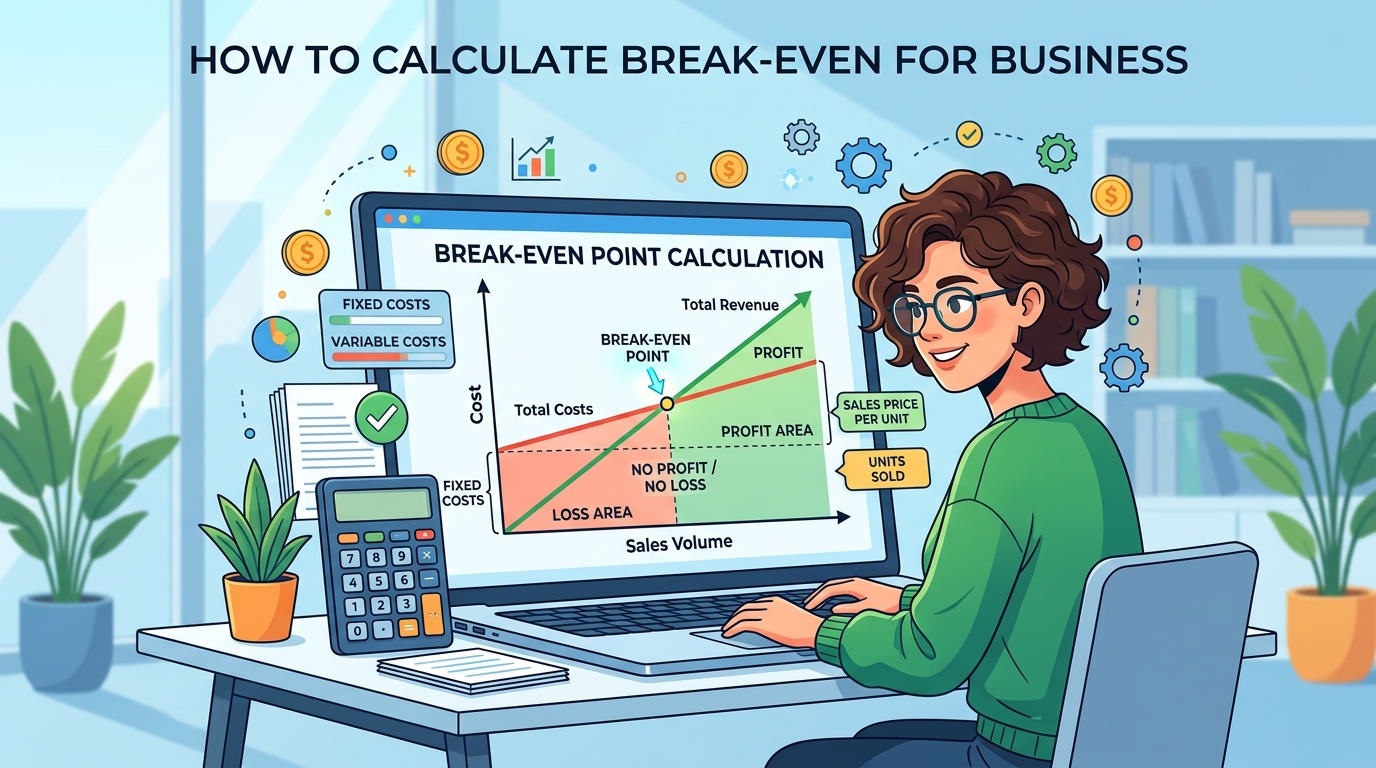
Every business owner, entrepreneur, or freelancer knows that understanding profits and losses is crucial to success. One of the most fundamental financial metrics you need is the break-even point. Knowing your break-even point allows you to determine when your business will start making a profit, ensuring smarter decisions for growth. In this guide, we’ll explain how to calculate break-even point, explore the break-even formula, and show you how to use a break-even calculator to simplify your calculations.
What is a Break-Even Point?
The break-even point (BEP) is the point at which total revenue equals total costs, meaning your business is neither making a profit nor a loss. Essentially, it is the sales volume at which you cover all your fixed and variable costs. Once you pass this point, your revenue contributes to profit.
- Fixed Costs: Costs that remain constant regardless of sales volume, e.g., rent, salaries, or insurance.
- Variable Costs: Costs that change with production or sales volume, e.g., raw materials, shipping, and packaging.
Understanding your break-even point is essential for pricing, budgeting, and financial planning.
Why Break-Even Analysis is Important
Conducting a break-even analysis provides multiple benefits:
- Pricing Strategy: Helps you set the right price for your product or service.
- Profit Planning: Shows the minimum sales volume needed to avoid losses.
- Investment Decisions: Helps investors understand the financial viability of your business.
- Risk Assessment: Identifies how changes in costs, prices, or sales volume impact profitability.
By using break-even analysis, businesses can make informed decisions and avoid financial pitfalls.
The Break-Even Formula
The standard formula for calculating the break-even point in units is:Break-Even Point (Units)=Selling Price per Unit−Variable Cost per UnitFixed Costs
- Fixed Costs (FC): Total fixed expenses.
- Selling Price per Unit (SP): Price at which each product is sold.
- Variable Cost per Unit (VC): Cost incurred to produce each unit.
For revenue-based break-even calculation:Break-Even Point (Revenue)=1−SalesVariable CostsFixed Costs
This formula provides the sales revenue required to cover all costs.
Step-by-Step Guide to Calculate Break-Even Point
Here’s how you can calculate your break-even point manually:
Step 1: Identify Fixed Costs
Add up all costs that remain constant regardless of production or sales, such as:
- Rent or mortgage payments
- Salaries and wages
- Insurance premiums
- Utilities
Example: If your fixed costs total $10,000 per month, that’s your starting point.
Step 2: Determine Variable Costs
Identify costs that change with each unit sold:
- Raw materials
- Packaging
- Shipping costs
- Sales commissions
Example: If your variable cost per product is $25 and you sell it for $50, the profit per unit is $25.
Step 3: Apply the Break-Even Formula
Use the formula:Break-Even Point=Selling Price per Unit – Variable Cost per UnitFixed Costs
Example:BEP=50−2510,000=400 units
You need to sell 400 units to reach your break-even point.
Step 4: Calculate Break-Even Revenue (Optional)
Multiply the break-even units by the selling price:400 units×$50=$20,000
Your business needs $20,000 in revenue to break even.
Common Mistakes in Break-Even Calculation
Even experienced business owners sometimes make mistakes during break-even calculation:
- Ignoring Variable Cost Changes: Variable costs may fluctuate with suppliers or seasons.
- Mixing Fixed and Variable Costs: Accurate separation is critical for reliable results.
- Overlooking Product Mix: If you sell multiple products, calculate the weighted average contribution margin.
- Not Updating Regularly: Costs and prices change—recalculate break-even point frequently.
By avoiding these mistakes, your break-even analysis will be accurate and actionable.
Using a Free Break-Even Calculator
Manually calculating the break-even point is straightforward but can become complex with multiple products or fluctuating costs. This is where a free break-even calculator comes in handy.
Benefits of Using a Break-Even Calculator:
- Quick Calculations: Get results in seconds.
- Accuracy: Reduces human error in complex formulas.
- Visual Representation: Many calculators provide graphs showing the break-even point.
- Scenario Analysis: Test how changes in costs or pricing affect profitability.
How to Use a Break-Even Calculator:
- Enter your fixed costs.
- Input your variable cost per unit.
- Enter your selling price per unit.
- Click “Calculate” to see your break-even point in units and revenue.
This tool is perfect for entrepreneurs who want to find their profit point quickly without digging through spreadsheets.
Break-Even Analysis for Different Business Models
Product-Based Businesses
For companies selling physical products:
- Break-even point helps determine pricing strategy.
- Helps plan production and inventory.
- Useful for seasonal sales planning.
Service-Based Businesses
For service providers:
- Focus on labor and material costs as variable costs.
- Determine minimum billable hours to cover expenses.
- Adjust service rates to reach break-even faster.
Multi-Product Businesses
If your business offers multiple products:
- Use the weighted average contribution margin.
- Allocate fixed costs proportionally across products.
- Break-even analysis becomes more complex but remains critical.
Advanced Break-Even Strategies
- Margin of Safety: Shows how much sales can drop before losses occur.
Margin of Safety=Current SalesCurrent Sales – Break-Even Sales×100
- Target Profit Analysis: Modify the formula to include desired profit:
Break-Even Units for Target Profit=Selling Price – Variable CostFixed Costs + Desired Profit
- Scenario Planning: Test “what-if” scenarios by adjusting costs, prices, or sales volume.
These strategies give deeper insights and help your business stay financially healthy.
Key Takeaways
- The break-even point shows when your business covers all costs.
- Use the break-even formula to calculate it manually.
- A break-even calculator simplifies calculations and provides visual insights.
- Regular break-even analysis ensures pricing, budgeting, and planning are optimized.
- Avoid common mistakes like ignoring variable costs or product mix.
Try Our Free Break-Even Calculator Today
Stop guessing and start planning with precision. Our free online break-even calculator helps you find your profit point in seconds. Enter your costs and prices to see how many units you need to sell to break even. It’s fast, accurate, and completely free—perfect for entrepreneurs, startups, and small businesses.
Don’t wait to discover your break-even point: try our calculator now and make informed business decisions!