
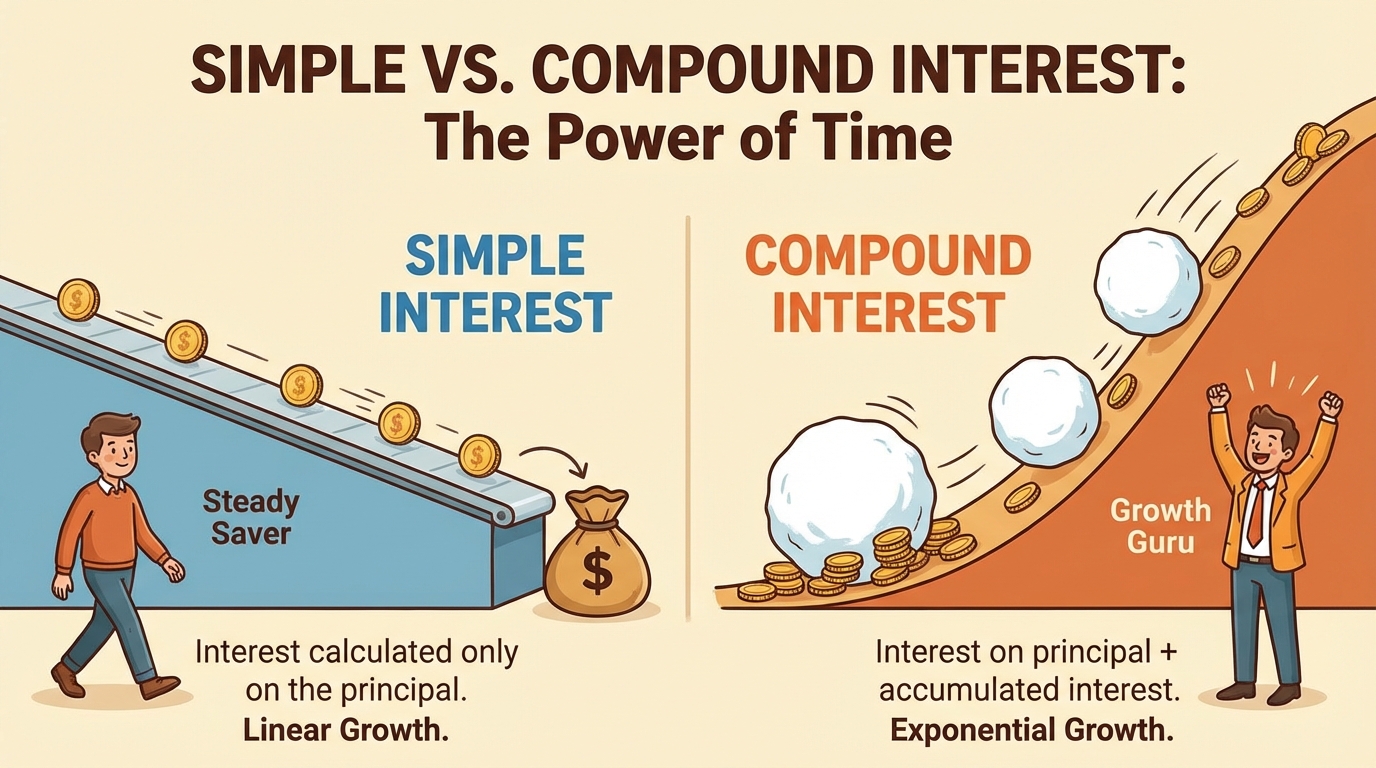
Interest plays a major role in finance, banking, loans, and investments. Whether you are saving money in a bank account or paying off a loan, understanding how interest works can help you make smarter financial decisions.
Two of the most common types of interest are simple interest and compound interest. While they may sound similar, they work very differently and can significantly affect how much money you earn or pay over time.
In this guide, you will learn:
- What simple interest is
- What compound interest is
- The key differences between simple and compound interest
- How to calculate both types of interest
- Real-life examples of interest calculations
- When to use simple vs compound interest
If you want to quickly estimate interest, you can also try our free interest calculation tool:
👉 Use the Simple Interest Calculator
This free tool lets you calculate interest instantly without complex formulas.
What Is Simple Interest?
Simple interest is the easiest type of interest calculation. It is calculated only on the original principal amount.
The principal is the initial amount of money you borrow or invest.
Unlike compound interest, simple interest does not accumulate on previous interest.
Simple Interest Formula
The formula for simple interest is:
Simple Interest = Principal × Rate × Time
Where:
- Principal (P) = initial amount of money
- Rate (R) = interest rate per year
- Time (T) = number of years
Example of Simple Interest
Let’s say you invest $1,000 at an annual interest rate of 5% for 3 years.
Calculation:
1000 × 0.05 × 3 = 150
The total interest earned would be $150.
Total amount after 3 years:
$1,000 + $150 = $1,150
Because simple interest only applies to the original amount, the interest stays consistent every year.
What Is Compound Interest?
Compound interest is more powerful because it calculates interest on both the principal and the accumulated interest.
This means your money grows faster over time.
Compound interest is often called “interest on interest.”
It is commonly used in:
- Savings accounts
- Investments
- Retirement funds
- Credit cards
- Loans
Compound Interest Formula
The compound interest formula is:
A = P (1 + r/n)^(nt)
Where:
- A = final amount
- P = principal
- r = annual interest rate
- n = number of times interest compounds per year
- t = number of years
This formula might look complicated, which is why many people prefer using an online calculator.
Example of Compound Interest
Let’s use the same example:
- Principal = $1,000
- Interest rate = 5%
- Time = 3 years
- Compounded yearly
Year 1:
$1,000 × 5% = $50
New balance:
$1,050
Year 2:
$1,050 × 5% = $52.50
New balance:
$1,102.50
Year 3:
$1,102.50 × 5% = $55.13
Final balance:
$1,157.63
Compared to simple interest ($1,150), compound interest gives you more earnings.
If you want to quickly estimate compound interest, you can also try our free compound interest calculation tool:
👉 Use the Compound Interest Calculator
This compound interest calculator is a free tool that lets you calculate compound interest instantly without complex formulas.
Simple Interest vs Compound Interest: Key Differences
Understanding the difference between these two interest types is essential when comparing loans or investments.
| Feature | Simple Interest | Compound Interest |
|---|---|---|
| Interest Calculation | Based only on principal | Based on principal + accumulated interest |
| Growth Speed | Linear | Exponential |
| Used For | Short-term loans | Investments and savings |
| Calculation Complexity | Simple formula | More complex formula |
The biggest difference is how interest grows over time.
Compound interest leads to faster growth, especially for long-term investments.
Why Compound Interest Is Powerful for Investments
Compound interest can significantly increase your wealth over time because of exponential growth.
This effect becomes stronger the longer you keep your money invested.
Example: 20-Year Investment
Initial investment:
$5,000
Interest rate:
6% annually
Simple interest after 20 years:
5000 × 0.06 × 20 = 6000
Total value:
$11,000
Compound interest after 20 years:
≈ $16,035
That’s over $5,000 more thanks to compounding.
This is why financial experts often recommend long-term investing.
When Is Simple Interest Used?
Simple interest is typically used for short-term financial products.
Common examples include:
- Personal loans
- Auto loans
- Short-term borrowing
- Basic savings calculations
Because the formula is straightforward, it is easy to estimate payments.
If you want to quickly estimate interest payments, try our calculator:
👉 Calculate Simple Interest Instantly
When Is Compound Interest Used?
Compound interest is commonly used in long-term financial products.
Examples include:
- Savings accounts
- Investment portfolios
- Retirement accounts
- Mutual funds
- Credit card balances
Because compound interest increases faster over time, it can either grow wealth or increase debt depending on the situation.
👉 Calculate Compound Interest Instantly
How to Calculate Simple Interest Quickly
While the formula is easy, calculating interest repeatedly can be time consuming.
Using an online calculator allows you to quickly determine:
- Total interest earned
- Final investment value
- Interest on loans
- Interest over time
Instead of manually calculating:
Principal × Rate × Time
you can simply enter your values and get instant results.
👉 Try the Simple Interest Calculator
Benefits of Using an Online Interest Calculator
Online calculators are popular because they simplify financial calculations.
1. Instant Results
You can calculate interest in seconds without doing manual math.
2. Accurate Calculations
Online tools reduce the chance of calculation mistakes.
3. Useful for Planning
Interest calculators help with:
- Loan planning
- Investment decisions
- Financial forecasting
4. Free and Accessible
Most online calculators are completely free and accessible from any device.
Our simple interest calculator works on both desktop and mobile devices.
Real-Life Applications of Interest Calculations
Understanding interest calculations helps in many financial situations.
Loans
When borrowing money, knowing the interest type helps you estimate repayment costs.
Savings Accounts
Compound interest allows your savings to grow over time.
Investments
Investors use compound interest to maximize long-term returns.
Credit Cards
Credit cards typically use compound interest, which can make debt grow quickly if balances aren’t paid.
Simple Interest vs Compound Interest: Which Is Better?
The answer depends on whether you are investing or borrowing.
For Investors
Compound interest is better because it helps your money grow faster.
For Borrowers
Simple interest is usually better because it prevents interest from accumulating.
Understanding this difference can help you make better financial decisions.
Use Our Free Interest Calculator
If you want to calculate interest quickly without complex formulas, try our free online tool.
👉 Use the Simple Interest Calculator
With this tool you can:
- Calculate interest instantly
- Estimate loan payments
- Plan savings growth
- Avoid complicated formulas
It only takes a few seconds to get accurate results.
Conclusion
Both simple interest and compound interest are important financial concepts.
Simple interest is easy to calculate and is commonly used for short-term loans.
Compound interest, however, allows money to grow faster because interest accumulates over time.
Understanding the difference between these two methods helps you make smarter financial decisions when borrowing, saving, or investing.
If you want to estimate interest quickly, try our free calculator today.