
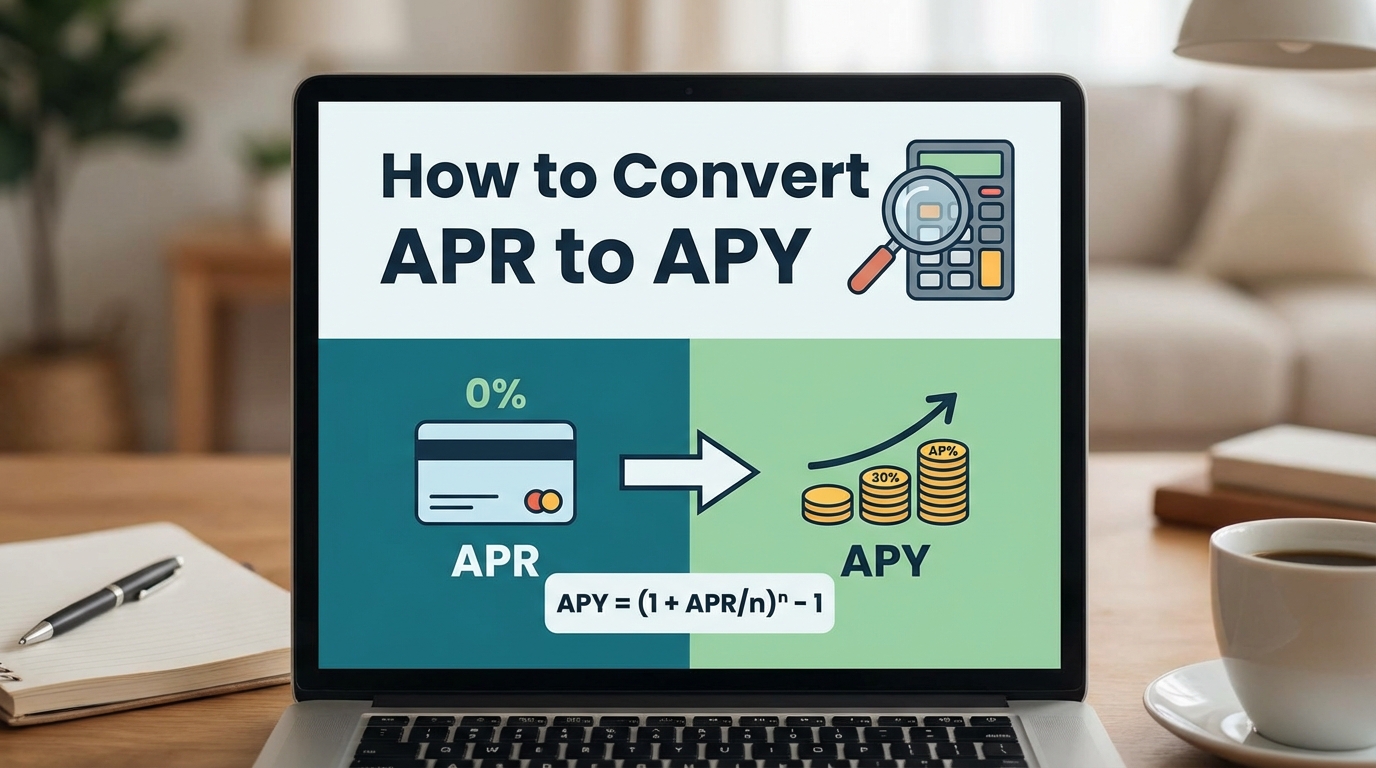
If you’ve ever shopped for loans, credit cards, or investment accounts, you’ve likely encountered two common financial terms: APR and APY. Understanding the difference and knowing how to convert APR to APY can help you make smarter financial decisions, compare interest rates accurately, and maximize your returns.
Fortunately, our free online Interest Rate Converter (APR ↔ APY) makes this process simple, accurate, and fast. In this guide, we’ll break down everything you need to know about APR, APY, and how to use an APR ↔ APY converter.
What is APR?
APR, or Annual Percentage Rate, represents the yearly interest rate charged on a loan or earned on an investment without taking compounding into account. APR is commonly used for credit cards, mortgages, and personal loans.
Key features of APR:
- Expressed as a percentage (%).
- Shows the interest cost per year.
- Does not account for compounding within the year.
For example, a loan with a 12% APR will accrue 12% interest over one year, but if interest is compounded monthly, the actual return (or cost) will be slightly higher. That’s where APY comes in.
What is APY?
APY, or Annual Percentage Yield, reflects the actual rate of return taking compounding into account. Unlike APR, APY tells you the true annual growth of your investment or the real cost of a loan.
Key features of APY:
- Accounts for interest compounding (daily, monthly, quarterly).
- Provides a more accurate measure of yearly earnings or costs.
- Always equal to or higher than APR when compounding occurs.
For example, if you have a savings account with a 12% APR compounded monthly, the APY would be slightly higher than 12% due to monthly compounding.
Why You Need to Convert APR to APY
Understanding how to convert APR to APY is essential because:
- Accurate Comparisons: APR alone doesn’t show how often interest is compounded. APY provides the full picture, especially for savings accounts or investment returns.
- Better Financial Planning: Knowing the APY helps you project your earnings or debt more accurately.
- Transparency: Lenders and banks often advertise APR, but the APY reveals the real cost or yield.
- Investment Decisions: For CDs, savings accounts, and money market accounts, APY helps you identify the best options for maximizing returns.
The Formula to Convert APR to APY
Converting APR to APY involves accounting for compounding. The general formula is:APY=(1+nAPR)n−1
Where:
- APR = Annual Percentage Rate (as a decimal, e.g., 12% = 0.12)
- n = Number of compounding periods per year (e.g., monthly = 12, daily = 365)
Example: APR to APY Conversion
Suppose you have a savings account offering 12% APR compounded monthly:APY=(1+120.12)12−1
Step-by-step:
- Divide APR by the number of compounding periods: 0.12 ÷ 12 = 0.01
- Add 1: 1 + 0.01 = 1.01
- Raise to the power of 12 (monthly compounding): 1.01¹² ≈ 1.1268
- Subtract 1: 1.1268 – 1 = 0.1268
APY ≈ 12.68%
This APR to APY calculation shows that monthly compounding increases your effective yield from 12% APR to 12.68% APY.
How to Convert APR to APY with Our Free Interest Rate Converter
Manually calculating APR to APY can be time-consuming, especially with different compounding periods. That’s why we designed a free online APR ↔ APY converter.
Benefits of Using Our Converter:
- Instant Calculations: Convert APR to APY or APY to APR in seconds.
- Accurate Results: Handles daily, monthly, quarterly, and yearly compounding.
- User-Friendly: Enter your APR and select compounding frequency—no complex math required.
- Versatile: Works for loans, credit cards, savings accounts, and investments.
Simply enter your interest rate and compounding frequency, and the Interest Rate Converter (APR ↔ APY) instantly gives you the result, making it easier to compare rates and make informed financial decisions.
Understanding Compounding Frequency
Compounding frequency plays a critical role in APR to APY conversion. Common frequencies include:
| Compounding Period | n (times/year) |
|---|---|
| Daily | 365 |
| Monthly | 12 |
| Quarterly | 4 |
| Semi-Annually | 2 |
| Annually | 1 |
The more frequent the compounding, the higher the APY will be compared to the APR. For example, 12% APR compounded daily results in a slightly higher APY than monthly compounding.
APR to APY Calculator vs. Manual Calculations
While the formula above works for converting APR to APY, using a reliable APR ↔ APY calculator has clear advantages:
- Error-Free: Eliminates mistakes in manual calculations.
- Time-Saving: Instantly computes results for multiple rates or scenarios.
- Comparison Ready: Allows easy side-by-side comparison of different accounts.
- Accessible Anywhere: Online tools are available on desktop and mobile.
Common Questions About APR and APY
1. Can APY be lower than APR?
- No, APY is equal to or greater than APR because it includes compounding. If there’s no compounding, APR = APY.
2. Which is better to compare for loans?
- Use APR to understand total cost but APY gives a clearer picture of compounding effects.
3. Do credit cards use APY?
- Most credit cards list APR. APY is more common for savings accounts, CDs, and investments.
4. Can I convert APY to APR?
- Yes! The reverse formula is:
APR=n×((1+APY)1/n−1)
Our APR ↔ APY converter can handle both directions effortlessly.
Why Our Interest Rate Converter is Essential
With financial options increasing every day, accurately comparing rates is crucial. Our Interest Rate Converter (APR ↔ APY) gives you:
- Fast Calculations: Save time and avoid complex formulas.
- Precision: Handles all compounding frequencies correctly.
- Clarity: Understand the real cost of loans or actual earnings from investments.
- Decision Power: Choose the best financial products with confidence.
Whether you’re a borrower looking for the lowest-cost loan or an investor seeking the highest-yield savings account, this tool helps you make smart, informed choices.
Conclusion
Knowing how to convert APR to APY is no longer optional—it’s essential for smart financial decisions. While manual calculations are possible, using a free online Interest Rate Converter (APR ↔ APY) ensures accuracy, speed, and convenience.
Stop guessing and start comparing rates the right way. Use our APR ↔ APY calculator to:
- Convert interest rates in seconds.
- Understand the true cost of borrowing.
- Maximize your investment returns.
Try it today and make your financial decisions simpler, smarter, and more profitable.