
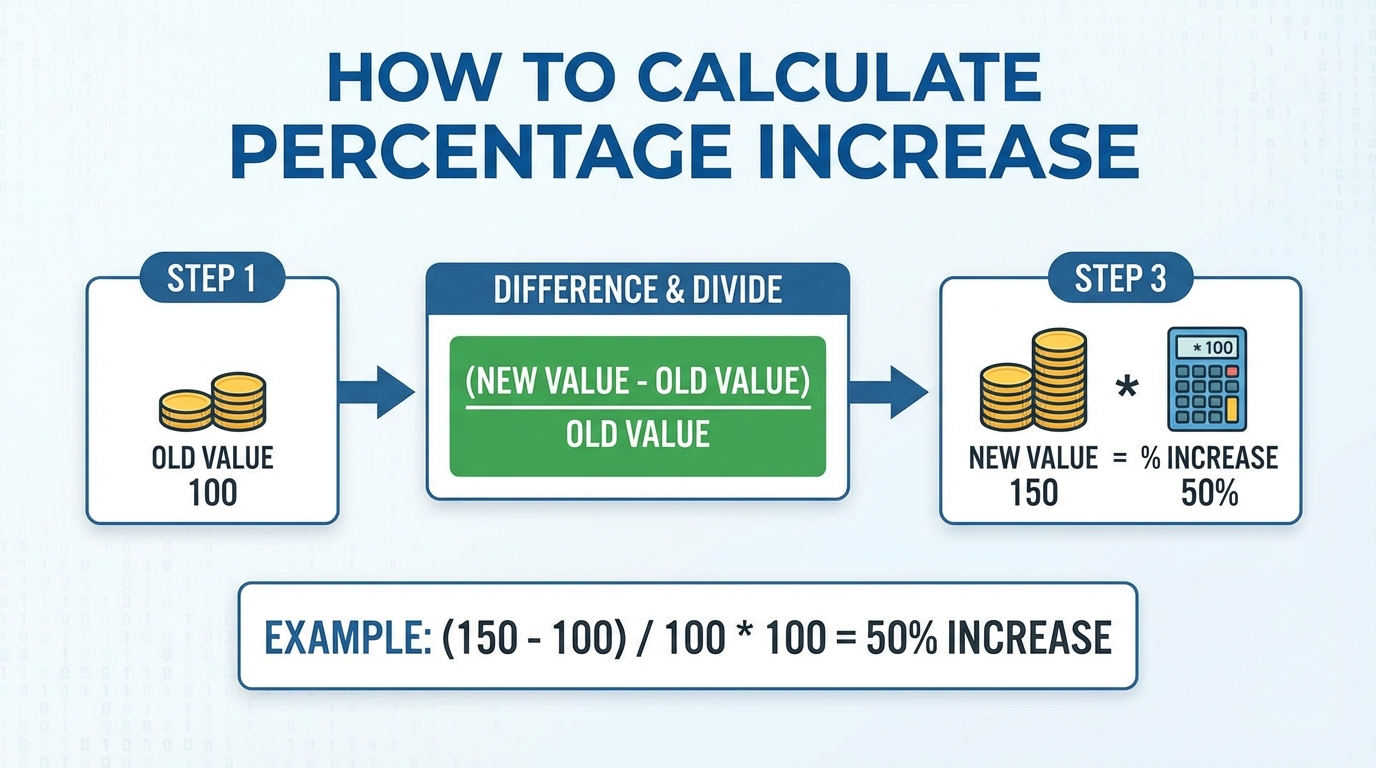
Understanding how to calculate percentage increase is an essential skill used in everyday life. From tracking salary growth to measuring business performance and analyzing price changes, percentage increases help you understand how much something has grown relative to its original value.
Many people search online for questions like:
- How do you calculate percentage increase?
- What is the percentage increase formula?
- How do you calculate percentage increase between two numbers?
Fortunately, calculating percentage increase is actually very simple once you understand the formula.
In this guide you will learn:
- What percentage increase means
- The simple formula for calculating percentage increase
- Step-by-step calculation examples
- Real-life examples like salary increases and price changes
- How to instantly calculate it using an online tool
If you want the fastest way to calculate percentage increases, you can use our free tool:
👉 Use our free percentage change calculator
What Is Percentage Increase?
Percentage increase measures how much a value has grown compared to its original amount.
Instead of simply showing the difference between two numbers, percentage increase shows how large that increase is relative to the starting value.
For example:
Original price: $100
New price: $120
The price increased by $20, but the percentage increase is 20%.
This allows you to compare growth more easily across different numbers.
Percentage increases are commonly used in:
- Business growth analysis
- Stock market performance
- Salary increases
- Price changes
- Website traffic growth
- Population statistics
Understanding how to calculate percentage increases helps you make better financial and analytical decisions.
Percentage Increase Formula
The basic formula for percentage increase is:
Percentage Increase = ((New Value − Original Value) / Original Value) × 100
This formula works for any type of number comparison.
Step-by-step explanation
- Subtract the original value from the new value
- Divide the difference by the original value
- Multiply the result by 100
This converts the increase into a percentage.
While this formula is simple, many people prefer using a calculator for faster results.
You can instantly calculate percentage changes using our free percentage increase decrease calculator.
Step-by-Step Example of Percentage Increase
Let’s walk through a simple example.
Example
A product price increases from $80 to $100.
Step 1: Find the difference
100 − 80 = 20
Step 2: Divide by the original value
20 ÷ 80 = 0.25
Step 3: Convert to percentage
0.25 × 100 = 25%
Final result:
The price increased by 25%.
Quick Way to Calculate Percentage Increase
If you want to skip manual calculations, the fastest way is using an online percentage change calculator.
Instead of doing the formula yourself, simply:
- Enter the original value
- Enter the new value
- Click calculate
The tool will instantly show the percentage increase.
You can try our free online percentage change calculator here. This method is faster and eliminates calculation mistakes.
Real-Life Examples of Percentage Increase
Percentage increases appear everywhere in real life. Here are some common examples of percentage increase.
Salary Increase Example
Suppose your salary increases from $3,000 to $3,300 per month.
Step 1:
3300 − 3000 = 300
Step 2:
300 ÷ 3000 = 0.10
Step 3:
0.10 × 100 = 10%
Your salary increased by 10%.
Price Increase Example
A laptop price increases from $900 to $1080.
Step 1:
1080 − 900 = 180
Step 2:
180 ÷ 900 = 0.20
Step 3:
0.20 × 100 = 20%
The price increased by 20%.
Website Traffic Growth Example
A website receives 5,000 visitors in January and 6,500 visitors in February.
Step 1:
6500 − 5000 = 1500
Step 2:
1500 ÷ 5000 = 0.30
Step 3:
0.30 × 100 = 30%
Website traffic increased by 30%.
Why Percentage Increase Is Important
Understanding percentage increases is important in many industries.
Financial planning
Investors track percentage increases to measure profit growth.
Business analytics
Companies measure percentage increases in:
- revenue
- customers
- sales
- marketing performance
Personal finance
Individuals use percentage increases to understand:
- salary raises
- interest earnings
- investment returns
Data analysis
Percentage change makes it easier to compare numbers across different scales.
Common Mistakes When Calculating Percentage Increase
Many people make simple mistakes when calculating percentage increases.
Using the wrong base number
The original value must always be used as the denominator in the formula.
Incorrect:
Difference ÷ New Value
Correct:
Difference ÷ Original Value
Forgetting to multiply by 100
The formula requires multiplying by 100 to convert the result into a percentage.
Without this step, the result will be a decimal.
Mixing increase and decrease of percentages
Make sure the new value is larger than the original value. If the new value is smaller, you are calculating percentage decrease instead.
Fastest Way to Calculate Percentage Increase Online
Manual calculations work well for learning, but if you need quick answers, an online calculator is the best solution.
Using a percentage change calculator allows you to:
- calculate increases instantly
- avoid manual math errors
- compare multiple values quickly
- save time
Our free percentage increase calculator makes it easy to find percentage increases in seconds.
Simply enter your numbers and get an accurate result immediately.
Tips for Calculating Percentage Increase Faster
Here are some quick tips to make calculations easier.
Convert percentages to decimals
10% = 0.10
25% = 0.25
50% = 0.50
This makes calculations faster.
Estimate first
If a price goes from $100 to $110, you already know the increase is roughly 10%.
Estimation helps verify your final calculation.
Use online tools
Using online percentage calculators removes the need for manual percentage formulas.
Percentage Increase vs Percentage Change
Many people confuse these terms.
Percentage Increase
Used when the value becomes larger.
Example:
100 → 120
Increase = 20%
Percentage Decrease
Used when the value becomes smaller.
Example:
120 → 100
Decrease = 16.67%
Percentage Change
A general term that includes both increase and decrease.
Our online percentage change calculator can calculate both. Use it for free!
When Should You Use a Percentage Change Calculator?
Using a percentage change calculator is especially useful when dealing with:
- financial data
- business analytics
- large numbers
- multiple comparisons
- quick calculations
Students, business owners, marketers, and investors all benefit from fast percentage calculations.
Learning how to calculate percentage increase
Learning how to calculate percentage increase is an important mathematical skill used in finance, business, education, and everyday life.
The key formula is simple:
((New Value − Original Value) / Original Value) × 100
Once you understand this formula, you can easily calculate growth in salaries, prices, investments, and more.
However, if you want the fastest and easiest solution, using an online calculator is the best option.
You can calculate percentage increases instantly using our free tool:
👉 https://utililtytoolshub.com/tools/percentage-change-calculator/
FAQ – How to Calculate Percentage Increase
What is percentage increase?
Percentage increase measures how much a value has grown compared to its original amount. It expresses the change as a percentage of the starting value, making it easier to compare growth between different numbers.
For example, if a price increases from $100 to $120, the difference is $20. When converted into a percentage, the increase is 20%.
What is the formula for percentage increase?
The formula for percentage increase is:
((New Value − Original Value) ÷ Original Value) × 100
This formula calculates the difference between the two numbers, divides it by the original value, and converts the result into a percentage.
How do you calculate percentage increase between two numbers?
To calculate the percentage increase between two numbers:
- Subtract the original number from the new number
- Divide the difference by the original number
- Multiply the result by 100
For example, if a number increases from 50 to 75:
Difference = 25
25 ÷ 50 = 0.5
0.5 × 100 = 50% increase
How do you calculate percentage increase quickly?
The fastest way to calculate percentage increase is by using an online calculator. Instead of manually applying formulas, you simply enter the original value and the new value.
You can instantly calculate it using the Percentage Change Calculator.
What is the difference between percentage increase and percentage change?
Percentage increase specifically refers to situations where a number becomes larger. Percentage change is a broader term that includes both increases and decreases.
For example:
- If a value rises from 100 to 120, it is a 20% increase
- If a value drops from 120 to 100, it is a 16.67% decrease
Both are considered percentage changes.
When should you use a percentage increase calculation?
Percentage increase is commonly used in situations such as:
- Salary raises
- Price increases
- Investment growth
- Business revenue growth
- Website traffic analysis
- Population growth
It helps people understand how much something has grown relative to its original value.