
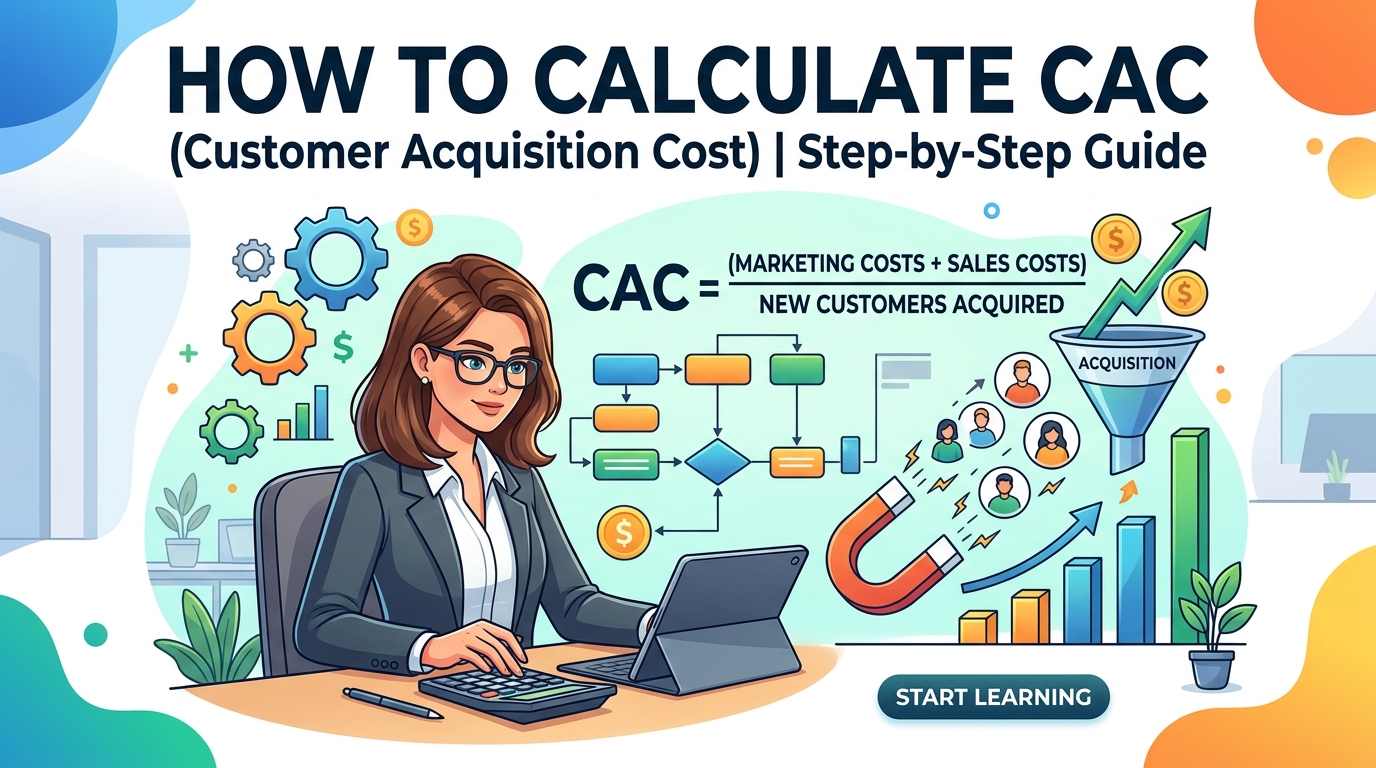
Customer Acquisition Cost (CAC) is one of the most important metrics in marketing, SaaS, e-commerce, and virtually any business that relies on customer growth. If you don’t know how to calculate CAC correctly, you risk overspending on marketing, underpricing your product, or scaling an unprofitable business.
In this guide, you’ll learn exactly how to calculate CAC, what the formula means, how to interpret it, common mistakes to avoid, and how to use CAC to grow your business efficiently. You’ll also discover why using a Customer Acquisition Cost calculator can save you time and improve accuracy.
What is Customer Acquisition Cost (CAC)?
Customer Acquisition Cost (CAC) is the total cost a business spends to acquire a new customer. It includes all marketing and sales expenses required to convince a potential customer to make a purchase.
In simple terms:
CAC tells you how much you are spending to gain one paying customer.
This metric helps businesses understand whether their marketing efforts are profitable or unsustainable.
If your CAC is higher than the revenue a customer generates, your business model is not viable in the long term.
Why CAC Matters for Every Business
Understanding how to calculate CAC is essential because it directly affects profitability, growth strategy, and pricing decisions.
Here’s why CAC is so important:
1. Profitability Measurement
CAC helps you determine whether you are spending too much to acquire customers compared to what they bring in.
2. Marketing Efficiency
It allows you to evaluate which marketing channels are performing best.
3. Budget Optimization
By understanding CAC, you can allocate your marketing budget more effectively.
4. Business Scalability
A scalable business typically has a stable or decreasing CAC over time.
5. Investor Confidence
Investors often analyze CAC alongside LTV (Lifetime Value) to assess business health.
The Basic CAC Formula
The standard formula for calculating Customer Acquisition Cost is:
CAC = Total Sales & Marketing Costs / Number of New Customers Acquired
Let’s break it down.
Total Sales & Marketing Costs
This includes all expenses related to acquiring customers, such as:
- Advertising spend (Google Ads, Facebook Ads, etc.)
- Content marketing costs
- Sales team salaries and commissions
- Marketing tools and software
- Agency fees
- Campaign production costs
Number of New Customers Acquired
This is the number of paying customers gained during a specific time period.
Step-by-Step Guide: How to Calculate CAC
Let’s go through a practical example so you fully understand how to calculate CAC.
Step 1: Define a Time Period
Choose a period such as:
- Monthly
- Quarterly
- Yearly
Consistency is key.
Step 2: Calculate Total Marketing & Sales Costs
Example:
- Google Ads: $5,000
- Facebook Ads: $3,000
- Marketing software: $500
- Sales team salaries: $6,500
Total = $15,000
Step 3: Count New Customers
Let’s say you acquired:
- 300 new customers
Step 4: Apply the Formula
CAC = 15,000 / 300 = $50
What Does Your CAC Mean?
Once you calculate CAC, the next step is understanding what it tells you.
Low CAC
A low CAC usually indicates:
- Efficient marketing
- Strong brand awareness
- Effective targeting
High CAC
A high CAC might indicate:
- Poor ad targeting
- Inefficient sales process
- High competition
- Weak conversion rates
However, high CAC is not always bad if your customer lifetime value is also high.
CAC vs LTV: The Most Important Relationship
One of the most important comparisons in business is:
CAC vs LTV (Lifetime Value)
LTV is the total revenue a customer generates during their relationship with your business.
Healthy Business Ratio:
A commonly accepted benchmark is:
LTV should be at least 3x CAC
For example:
- CAC = $50
- LTV = $150
This is considered a healthy and scalable model.
If CAC is higher than LTV, your business loses money on every customer.
Different Types of CAC You Should Know
Not all CAC calculations are the same. Depending on your business, you may need different variations.
1. Blended CAC
Includes all marketing and sales costs divided by all customers.
2. Paid CAC
Only includes paid advertising costs.
3. Organic CAC
Focuses on SEO, content, and non-paid channels.
4. Channel-Specific CAC
Calculates CAC for individual channels like Google Ads or TikTok.
Understanding these variations helps you identify which channels are most efficient.
Common Mistakes When Calculating CAC
Many businesses calculate CAC incorrectly, leading to poor decisions.
1. Ignoring Hidden Costs
Many companies forget to include:
- Software tools
- Agency fees
- Employee overhead
2. Wrong Time Period Matching
Costs and customer numbers must match the same time frame.
3. Not Separating Channels
Blended CAC can hide underperforming channels.
4. Including Non-Acquisition Costs
Not all marketing costs are acquisition-related.
5. Overlooking Retention Impact
CAC should always be analyzed alongside retention and LTV.
How to Lower Your CAC
Reducing CAC is one of the fastest ways to improve profitability.
1. Improve Conversion Rates
Even small improvements in conversion rates reduce CAC significantly.
2. Optimize Ad Targeting
Better targeting means less wasted spend.
3. Invest in SEO
Organic traffic lowers dependency on paid ads.
4. Use Retargeting Campaigns
Retargeting often converts cheaper than cold traffic.
5. Improve Sales Funnel Efficiency
A smoother funnel reduces drop-offs.
6. Strengthen Branding
Strong brands naturally reduce CAC over time.
CAC in SaaS, E-commerce, and Startups
CAC behaves differently depending on your industry.
SaaS Companies
- Focus heavily on LTV
- Often accept higher CAC due to subscriptions
E-commerce
- CAC must be tightly controlled due to low margins
- Heavy reliance on paid ads
Startups
- Often prioritize growth over CAC initially
- Must monitor CAC carefully during scaling
Why Manual CAC Calculation is Not Enough
While the formula is simple, real-world CAC calculation is complex because:
- Costs come from multiple sources
- Channels overlap
- Attribution is not always clear
- Data is often scattered across platforms
That’s why many businesses use automated tools instead of spreadsheets.
Use a CAC Calculator for Accurate Results
Instead of manually calculating everything, you can use a Customer Acquisition Cost calculator to:
- Save time
- Avoid calculation errors
- Track CAC over time
- Compare channels easily
- Make data-driven decisions faster
A good CAC calculator helps you instantly understand your marketing efficiency without needing complex spreadsheets or formulas.
👉 If you want to simplify your analysis, try our free online Customer Acquisition Cost calculator to get instant and accurate results.
How to Use CAC to Grow Your Business
CAC is not just a number—it’s a decision-making tool.
Here’s how successful companies use it:
1. Budget Allocation
Invest more in channels with lower CAC.
2. Pricing Strategy
Ensure pricing supports CAC + profit margin.
3. Scaling Decisions
Scale only when CAC is stable or decreasing.
4. Product Optimization
Improve product-market fit to reduce acquisition friction.
5. Investor Reporting
Use CAC trends to demonstrate efficiency and scalability.
Advanced CAC Optimization Strategies
If you want to take CAC optimization further, consider these advanced tactics:
1. Multi-Touch Attribution
Understand the full customer journey.
2. Cohort Analysis
Measure CAC over time for different customer groups.
3. Predictive Analytics
Forecast future CAC based on trends.
4. Marketing Mix Modeling
Identify how channels interact and influence each other.
Final Thoughts
Knowing how to calculate CAC is essential for any business that wants to grow profitably. The formula is simple, but the insights it provides are powerful.
By understanding your Customer Acquisition Cost, you can:
- Improve marketing efficiency
- Increase profitability
- Make smarter scaling decisions
- Build a sustainable business model
But manual calculations can only take you so far. For faster, more accurate insights, using a Customer Acquisition Cost calculator is the smartest way to stay ahead.