
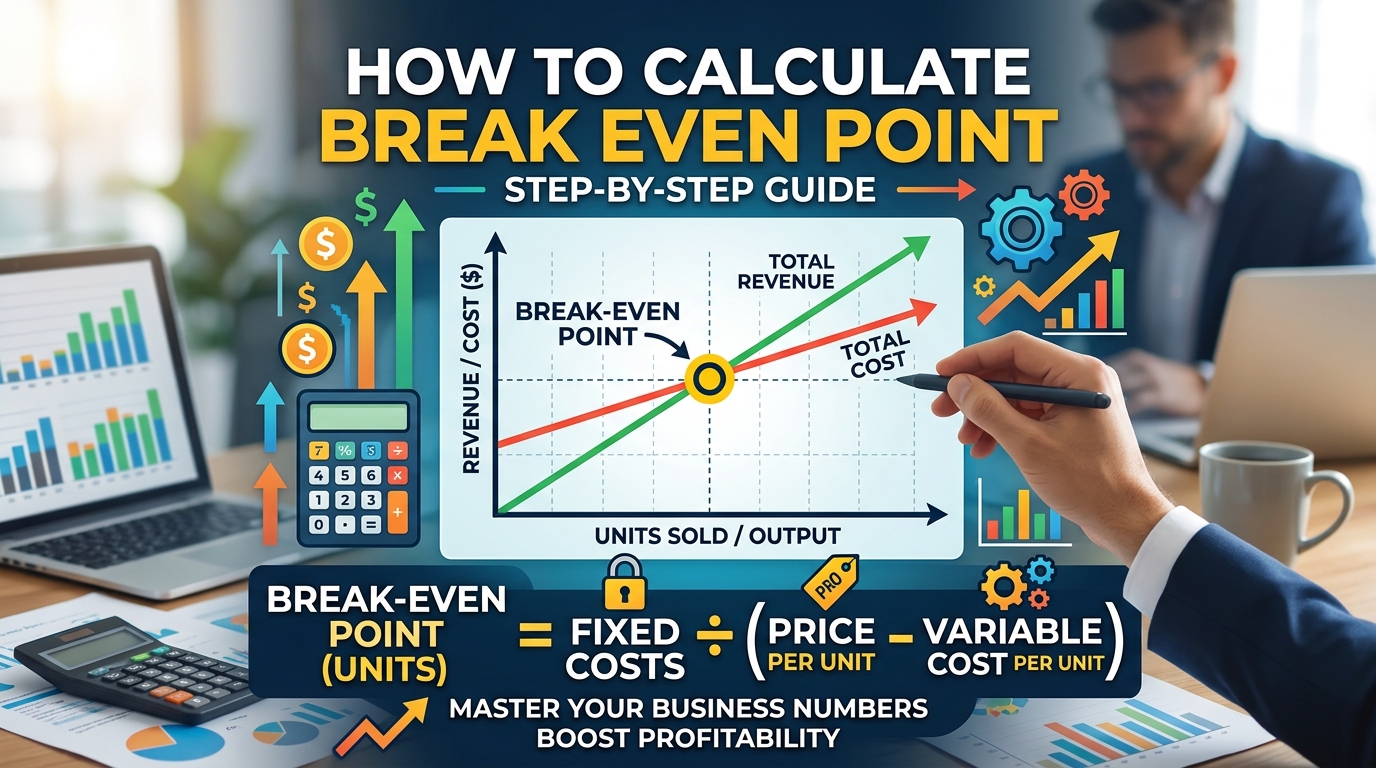
Understanding how to calculate break even point is essential for any business that wants to become profitable, control costs, and set smart pricing strategies. Whether you run a startup, an eCommerce store, a service-based business, or a manufacturing company, knowing your break-even point helps you understand exactly when your business stops losing money and starts making profit.
In this detailed guide, you will learn everything about break even calculation, including the break even formula, real-life examples, and how to use a break even calculator to simplify the process.
If you want instant results, you can also use our free tool to calculate break even point.
What Is Break Even Point?
The break even point (BEP) is the point at which your total revenue equals your total costs. At this point, your business is neither making a profit nor a loss.
In simple terms:
Break even point = where income = expenses
Once you pass the break-even point, every additional sale contributes to profit.
Why Break Even Analysis Is Important
Understanding how to calculate break even point is crucial for business success. It helps you:
- Determine minimum sales needed to avoid losses
- Set realistic pricing strategies
- Evaluate business viability before launching
- Control fixed and variable costs
- Plan growth and investment decisions
- Reduce financial risk
Break-even analysis is especially useful for startups and small businesses trying to understand financial sustainability.
Break Even Formula (Core Concept)
The basic break even formula is:Break Even Point (Units)=Selling Price per Unit−Variable Cost per UnitFixed Costs
Where:
- Fixed Costs = Costs that do not change (rent, salaries, insurance)
- Variable Costs = Costs per product (materials, shipping, packaging)
- Selling Price per Unit = Price at which you sell one unit
How to Calculate Break Even Point (Step-by-Step)
If you’re wondering how to calculate break even, follow this simple step-by-step process:
Step 1: Identify Fixed Costs
These are costs that remain constant regardless of how much you sell.
Examples:
- Rent
- Salaries
- Utilities
- Software subscriptions
Step 2: Identify Variable Costs per Unit
These are costs that increase with each unit sold.
Examples:
- Raw materials
- Packaging
- Shipping
- Transaction fees
Step 3: Determine Selling Price per Unit
This is the price customers pay for one unit of your product or service.
Step 4: Apply the Break Even Formula
Now plug the numbers into the break even formula:Break Even Units=Price−Variable CostFixed Costs
Example of Break Even Calculation
Let’s say you run a small online business:
- Fixed Costs = €5,000 per month
- Selling Price per Product = €50
- Variable Cost per Product = €30
Step 1: Calculate Contribution Margin
€50 − €30 = €20
Step 2: Apply Formula
Break Even Point=205000=250 units
Final Result:
You need to sell 250 units per month to break even.
What Is a Break Even Calculator?
A break even calculator is a tool that automatically performs the break even calculation for you. Instead of manually applying formulas, you simply input:
- Fixed costs
- Variable costs
- Selling price
And the tool instantly shows your break-even point.
👉 Try our free Break Even Calculator.
Benefits of Using a Break Even Calculator
Using a break even point calculator saves time and reduces errors. Key benefits include:
1. Fast Results
No need to manually calculate formulas.
2. Accurate Planning
Avoid miscalculations in financial forecasting.
3. Better Decision-Making
Understand pricing strategies and cost structure.
4. Scenario Testing
You can quickly test different pricing models.
5. Business Strategy Optimization
Helps you identify the most profitable path forward.
How Do You Calculate Break Even Point in Sales Revenue?
Instead of units, you can calculate break even in revenue terms:Break Even Revenue=Contribution Margin RatioFixed Costs
Where:Contribution Margin Ratio=Selling PriceSelling Price – Variable Cost
Example of break even calculation:
- Fixed Costs = €10,000
- Selling Price = €100
- Variable Cost = €60
Contribution Margin Ratio:
(100 − 60) ÷ 100 = 0.4
Break Even Revenue:
10,000 ÷ 0.4 = €25,000
Final Result:
You must generate €25,000 in sales revenue to break even.
Break Even Point vs Profit
It’s important to understand the difference:
| Concept | Meaning |
|---|---|
| Break Even Point | No profit, no loss |
| Profit | Revenue exceeds costs |
| Loss | Costs exceed revenue |
Once you pass the break-even point, your business starts generating profit.
Types of Costs in Break Even Analysis
Fixed Costs
Do not change with production level:
- Rent
- Salaries
- Insurance
Variable Costs
Change depending on output:
- Raw materials
- Packaging
- Delivery costs
Semi-Variable Costs
A mix of both:
- Utility bills
- Commission-based salaries
Understanding these is key to accurate break even calculation.
Common Mistakes in Break Even Calculation
1. Ignoring Hidden Costs
Many businesses forget fees like taxes or platform commissions.
2. Incorrect Cost Classification
Mixing fixed and variable costs leads to wrong results.
3. Overestimating Sales Price
Inflated pricing assumptions distort the break-even point.
4. Not Updating Regularly
Costs change over time, so calculations must be updated frequently.
How to Lower Your Break Even Point
Reducing your break-even point makes your business more profitable faster.
1. Reduce Fixed Costs
- Move to cheaper office space
- Automate processes
- Cut unnecessary subscriptions
2. Reduce Variable Costs
- Negotiate supplier prices
- Improve production efficiency
- Reduce waste
3. Increase Selling Price
If market allows, even small increases improve margins.
4. Improve Product Mix
Focus on high-margin products.
Real-World Example: Small Business Break Even Analysis
Let’s analyze a café:
- Fixed Costs = €8,000/month
- Average price per coffee = €3
- Variable cost per coffee = €1
Contribution margin:
3 − 1 = €2
Break even units:
8,000 ÷ 2 = 4,000 coffees
Conclusion:
The café must sell 4,000 coffees per month just to cover costs.
Why Break Even Analysis Is Essential for Startups
Startups often fail due to lack of financial planning. Knowing how to calculate break even point helps entrepreneurs:
- Understand funding needs
- Avoid pricing mistakes
- Evaluate business models
- Present data to investors
- Reduce financial uncertainty
Investors often require break-even analysis before funding a business.
Break Even Point Calculator vs Manual Calculation
While manual break even calculation is useful for understanding the concept, using a break even point calculator is better for:
- Speed
- Accuracy
- Testing multiple scenarios
- Financial planning
👉 Use our free break even calculator tool here.
Final Thoughts
Knowing how to calculate break even point is a fundamental financial skill for any business owner. Whether you use the break even formula manually or rely on a break even calculator, understanding this metric helps you make smarter pricing, cost, and growth decisions.
Break-even analysis answers one of the most important business questions:
“How much do I need to sell to avoid losing money?”
Once you know that number, you can build a more profitable and sustainable business.
FAQ: How to Calculate Break Even Point
What is the break even point in business?
The break even point is the level of sales where total revenue equals total costs. At this point, a business makes no profit and no loss. Any sales beyond this point generate profit.
How do you calculate break even point?
You calculate break even point using the formula:
Break Even Point (Units) = Fixed Costs ÷ (Selling Price per Unit − Variable Cost per Unit)
This shows how many units you need to sell to cover all costs.
What is the break even formula?
The standard break even formula is:
Break Even Point = Fixed Costs ÷ Contribution Margin
Where contribution margin equals selling price minus variable cost per unit.
How to calculate break even in sales revenue?
To calculate break even in revenue, use:
Break Even Revenue = Fixed Costs ÷ Contribution Margin Ratio
This tells you how much total sales revenue is needed to cover all costs.
What is a break even calculator?
A break even calculator is an online tool that automatically calculates your break even point. You enter fixed costs, variable costs, and selling price, and it instantly shows how many units or revenue you need to break even.
👉 You can try a free tool here: https://utililtytoolshub.com/tools/break-even-calculator/
How do you calculate break even point for a small business?
For a small business, you calculate break even by identifying fixed costs (like rent and salaries), variable costs (like materials), and selling price, then applying the break even formula to find how many units must be sold.
Why is break even analysis important?
Break even analysis helps businesses understand when they will start making profit. It is important for pricing strategy, financial planning, cost control, and business decision-making.
What is the difference between fixed and variable costs?
Fixed costs stay the same regardless of sales volume (rent, salaries), while variable costs change depending on production or sales (materials, shipping, packaging).
What happens after you reach the break even point?
After reaching the break even point, every additional sale generates profit because all fixed and variable costs are already covered.
What is a good break even point?
A good break even point depends on your industry and business model. Generally, a lower break even point is better because it means you need fewer sales to become profitable.
{ “@context”: “https://schema.org”, “@type”: “FAQPage”, “mainEntity”: [ { “@type”: “Question”, “name”: “What is the break even point in business?”, “acceptedAnswer”: { “@type”: “Answer”, “text”: “The break even point is the level of sales where total revenue equals total costs, meaning no profit and no loss.” } }, { “@type”: “Question”, “name”: “How do you calculate break even point?”, “acceptedAnswer”: { “@type”: “Answer”, “text”: “Break even point is calculated by dividing fixed costs by the difference between selling price per unit and variable cost per unit.” } }, { “@type”: “Question”, “name”: “What is the break even formula?”, “acceptedAnswer”: { “@type”: “Answer”, “text”: “The break even formula is Fixed Costs divided by Contribution Margin, where contribution margin equals selling price minus variable cost per unit.” } }, { “@type”: “Question”, “name”: “How to calculate break even in sales revenue?”, “acceptedAnswer”: { “@type”: “Answer”, “text”: “Break even revenue is calculated by dividing fixed costs by the contribution margin ratio.” } }, { “@type”: “Question”, “name”: “What is a break even calculator?”, “acceptedAnswer”: { “@type”: “Answer”, “text”: “A break even calculator is an online tool that calculates the break even point automatically based on fixed costs, variable costs, and selling price.” } }, { “@type”: “Question”, “name”: “How do you calculate break even point for a small business?”, “acceptedAnswer”: { “@type”: “Answer”, “text”: “For a small business, break even is calculated by dividing fixed costs by the contribution margin per unit.” } }, { “@type”: “Question”, “name”: “Why is break even analysis important?”, “acceptedAnswer”: { “@type”: “Answer”, “text”: “Break even analysis helps businesses determine when they will start making profit and supports pricing and financial decisions.” } }, { “@type”: “Question”, “name”: “What is the difference between fixed and variable costs?”, “acceptedAnswer”: { “@type”: “Answer”, “text”: “Fixed costs remain constant regardless of production, while variable costs change depending on output and sales volume.” } }, { “@type”: “Question”, “name”: “What happens after you reach the break even point?”, “acceptedAnswer”: { “@type”: “Answer”, “text”: “After reaching the break even point, every additional sale generates profit because all costs have been covered.” } }, { “@type”: “Question”, “name”: “What is a good break even point?”, “acceptedAnswer”: { “@type”: “Answer”, “text”: “A good break even point is typically lower, meaning fewer sales are required to cover all costs and start generating profit.” } } ] }