
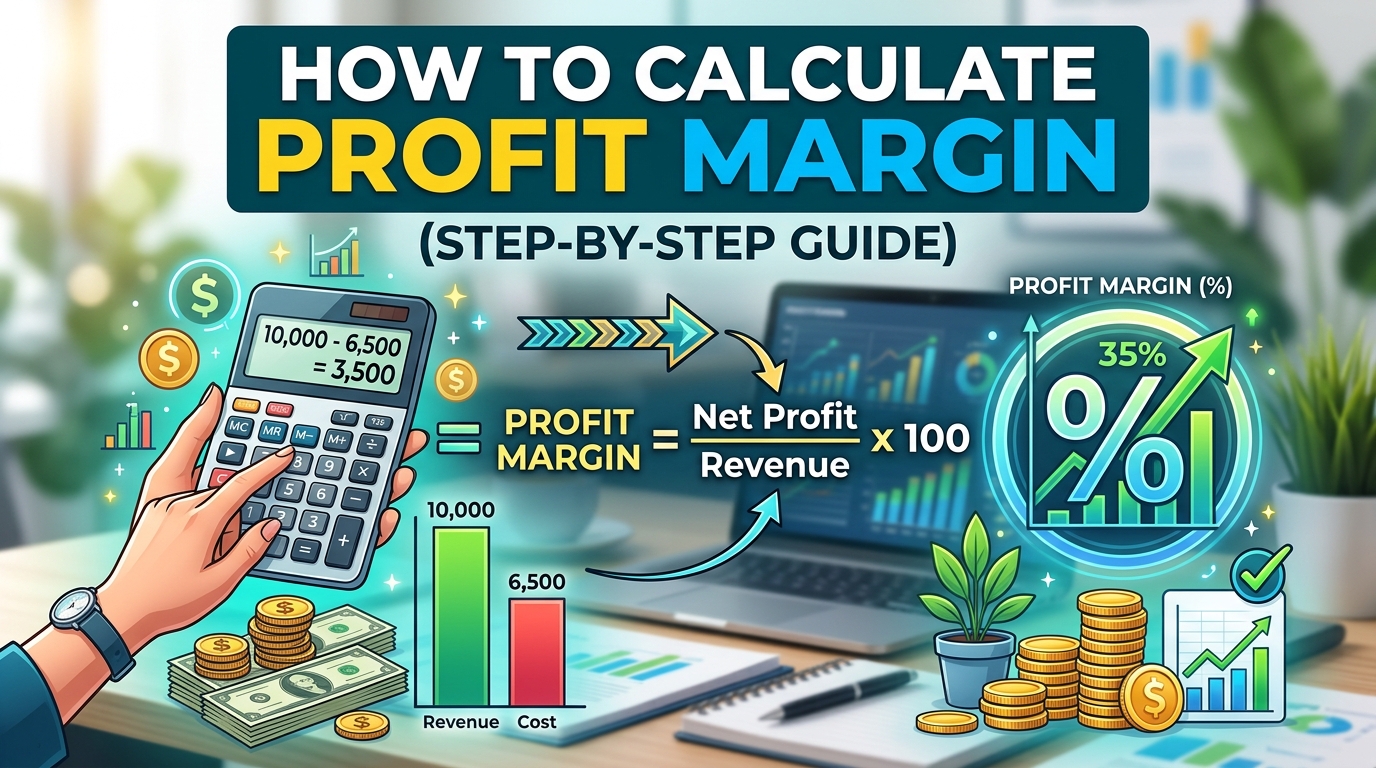
Understanding how to calculate profit margin is one of the most important financial skills for any business owner, entrepreneur, or investor. Profit margin reveals how efficiently a company turns revenue into profit and provides insight into pricing strategies, cost management, and overall financial health.
In this comprehensive guide, you’ll learn exactly how to calculate profit margin, including gross profit margin, net profit margin, and profit margin percentage, along with practical examples and expert tips to improve your numbers.
What Is Profit Margin?
Profit margin is a financial metric that measures how much profit a business makes relative to its revenue. It is usually expressed as a percentage and helps determine how efficiently a company operates.
In simple terms:
Profit margin tells you how much of every dollar earned is actual profit.
For example, if your business earns €100 and keeps €20 as profit, your profit margin is 20%.
Why Profit Margin Matters
Profit margin is critical for several reasons:
- Evaluates business performance – Shows how efficiently your company operates
- Supports pricing decisions – Helps determine if your prices are too high or too low
- Attracts investors – Higher margins often signal a healthier business
- Compares competitors – Lets you benchmark against industry standards
- Guides cost control – Identifies areas where expenses can be reduced
Without understanding profit margins, it’s nearly impossible to make informed financial decisions.
Calculate Profit Margin Formula
Before diving into specific types, let’s look at the general formula:Profit Margin=RevenueProfit×100
Where:
- Profit = Revenue − Costs
- Revenue = Total income from sales
How to Calculate Profit Margin Percentage
The profit margin percentage is simply the general formula expressed as a percentage.
Formula:
Profit Margin Percentage=(RevenueRevenue−Costs)×100
Example:
- Revenue = €1,000
- Costs = €700
- Profit = €300
Profit Margin=1000300×100=30%
Result: Your profit margin is 30%
How to Calculate Gross Profit Margin
Gross profit margin focuses on the profitability of your core business activities. It only considers the cost of goods sold (COGS)—the direct costs of producing goods or services.
Formula:
Gross Profit Margin=RevenueRevenue−COGS×100
What Is Included in COGS?
COGS typically includes:
- Raw materials
- Direct labor
- Manufacturing costs
It does not include:
- Marketing expenses
- Rent
- Administrative costs
Example:
- Revenue = €5,000
- COGS = €3,000
- Gross Profit = €2,000
Gross Profit Margin=50002000×100=40%
Result: Your gross profit margin is 40%
How to Calculate Net Profit Margin
Net profit margin is the most comprehensive measure of profitability. It accounts for all expenses, including operating costs, taxes, and interest.
Formula:
Net Profit Margin=RevenueNet Profit×100
What Is Included?
Net profit includes:
- Cost of goods sold
- Operating expenses
- Taxes
- Interest payments
- Depreciation
Example:
- Revenue = €5,000
- Total expenses = €4,200
- Net profit = €800
Net Profit Margin=5000800×100=16%
Result: Your net profit margin is 16%
Gross vs Net Profit Margin Differences
| Metric | Gross Profit Margin | Net Profit Margin |
|---|---|---|
| Includes costs | Direct costs only | All expenses |
| Purpose | Measures production efficiency | Measures overall profitability |
| Accuracy | Less comprehensive | Most accurate |
| Use case | Pricing strategy | Financial health analysis |
Both metrics are important and should be used together for a complete picture.
How to Interpret Profit Margins
A “good” profit margin depends on your industry, but here are general benchmarks:
- Low margin: 5% or less
- Average margin: 10%–20%
- High margin: 20%+
For example:
- Retail businesses often have lower margins
- Software companies typically have higher margins
Common Mistakes When Calculating Profit Margin
1. Ignoring Hidden Costs
Many businesses forget to include expenses like taxes or subscriptions, leading to inflated margins.
2. Confusing Gross and Net Profit
Using gross profit instead of net profit can give a misleading picture of financial health.
3. Using Incorrect Revenue Figures
Always use total revenue, not just profit or partial income.
4. Not Updating Calculations Regularly
Profit margins should be monitored consistently, not just once.
How to Improve Your Profit Margin
Improving profit margin is essential for business growth. Here are proven strategies:
1. Increase Prices Strategically
If demand allows, even small price increases can significantly boost margins.
2. Reduce Costs
- Negotiate with suppliers
- Optimize production processes
- Cut unnecessary expenses
3. Improve Efficiency
Automation and better workflows can lower operational costs.
4. Focus on High-Margin Products
Identify and promote products with the best margins.
5. Reduce Waste
Minimize inventory loss and streamline operations.
Real-World Example: Small Business Profit Margin Calculation
Let’s say you run an online store:
- Revenue = €10,000
- Cost of goods sold = €6,000
- Operating expenses = €2,500
Step 1: Gross Profit
€10,000 − €6,000 = €4,000Gross Margin=100004000×100=40%
Step 2: Net Profit
€4,000 − €2,500 = €1,500Net Margin=100001500×100=15%
Conclusion:
- Gross margin = 40%
- Net margin = 15%
This shows that while the product is profitable, operating costs significantly reduce overall profit.
Profit Margin vs Markup
Many people confuse profit margin with markup, but they are different.
Profit Margin Formula:
RevenueProfit×100
Markup Formula:
CostProfit×100
Example:
- Cost = €50
- Selling price = €100
- Profit = €50
- Markup = 100%
- Profit margin = 50%
Understanding this difference is crucial for pricing correctly.
Tools to Calculate Profit Margin
You can calculate profit margins using:
- Spreadsheet software like Excel or Google Sheets
- Accounting tools like QuickBooks or Xero
- Our free online profit margin calculator
Automating calculations reduces errors and saves time.
Industry-Specific Profit Margins
Profit margins vary widely depending on the industry:
- Retail: 2%–10%
- Restaurants: 3%–6%
- Software/SaaS: 20%–40%+
- Consulting: 15%–30%
Always compare your margin to industry averages for better insights.
Final Thoughts
Knowing how to calculate profit margin is essential for running a successful business. Whether you’re analyzing gross profit margin, net profit margin, or simply calculating your profit margin percentage, these metrics give you powerful insights into your financial performance.
By mastering these formulas and regularly tracking your margins, you can:
- Make smarter pricing decisions
- Control costs effectively
- Increase profitability
- Grow your business sustainably
FAQ: How do you Calculate Profit Margin
What is profit margin?
Profit margin is a financial metric that shows how much profit a business makes from its total revenue. It is expressed as a percentage and indicates how efficiently a company converts sales into actual profit.
How do you calculate profit margin?
You calculate profit margin using this formula:
Profit Margin = (Profit ÷ Revenue) × 100
First subtract total costs from revenue to get profit, then divide by revenue and multiply by 100 to get the percentage.
How do you calculate gross profit margin?
Gross profit margin is calculated using:
Gross Profit Margin = (Revenue − Cost of Goods Sold) ÷ Revenue × 100
It measures how efficiently a company produces and sells its goods or services before other expenses are considered.
How do you calculate net profit margin?
Net profit margin is calculated using:
Net Profit Margin = Net Profit ÷ Revenue × 100
It includes all expenses such as operating costs, taxes, and interest, making it the most accurate measure of profitability.
What is a good profit margin?
A good profit margin depends on the industry. Generally:
- 5% or less = low margin
- 10%–20% = average margin
- 20%+ = strong margin
Industries like software often have higher margins than retail or restaurants.
What is the difference between gross and net profit margin?
Gross profit margin only includes direct production costs (COGS), while net profit margin includes all business expenses such as taxes, rent, and operating costs.
Why is profit margin important?
Profit margin is important because it helps businesses:
- Measure financial performance
- Improve pricing strategies
- Control costs
- Compare performance with competitors
- Attract investors
What is the formula for profit margin percentage?
The formula is:
Profit Margin Percentage = (Revenue − Costs) ÷ Revenue × 100
This shows what percentage of revenue is actual profit.
{ “@context”: “https://schema.org”, “@type”: “FAQPage”, “mainEntity”: [ { “@type”: “Question”, “name”: “What is profit margin?”, “acceptedAnswer”: { “@type”: “Answer”, “text”: “Profit margin is a financial metric that shows how much profit a business makes from its total revenue, expressed as a percentage.” } }, { “@type”: “Question”, “name”: “How do you calculate profit margin?”, “acceptedAnswer”: { “@type”: “Answer”, “text”: “Profit margin is calculated by dividing profit by revenue and multiplying by 100. Profit equals revenue minus total costs.” } }, { “@type”: “Question”, “name”: “How do you calculate gross profit margin?”, “acceptedAnswer”: { “@type”: “Answer”, “text”: “Gross profit margin is calculated by subtracting cost of goods sold from revenue, dividing by revenue, and multiplying by 100.” } }, { “@type”: “Question”, “name”: “How do you calculate net profit margin?”, “acceptedAnswer”: { “@type”: “Answer”, “text”: “Net profit margin is calculated by dividing net profit (after all expenses) by revenue and multiplying by 100.” } }, { “@type”: “Question”, “name”: “What is a good profit margin?”, “acceptedAnswer”: { “@type”: “Answer”, “text”: “A good profit margin depends on the industry, but generally 10% to 20% is considered average, while above 20% is strong.” } }, { “@type”: “Question”, “name”: “What is the difference between gross and net profit margin?”, “acceptedAnswer”: { “@type”: “Answer”, “text”: “Gross profit margin only includes direct production costs, while net profit margin includes all business expenses such as taxes and operating costs.” } }, { “@type”: “Question”, “name”: “Why is profit margin important?”, “acceptedAnswer”: { “@type”: “Answer”, “text”: “Profit margin helps businesses evaluate performance, improve pricing strategies, control costs, and attract investors.” } }, { “@type”: “Question”, “name”: “What is the formula for profit margin percentage?”, “acceptedAnswer”: { “@type”: “Answer”, “text”: “Profit margin percentage is calculated by subtracting costs from revenue, dividing by revenue, and multiplying by 100.” } } ] }