
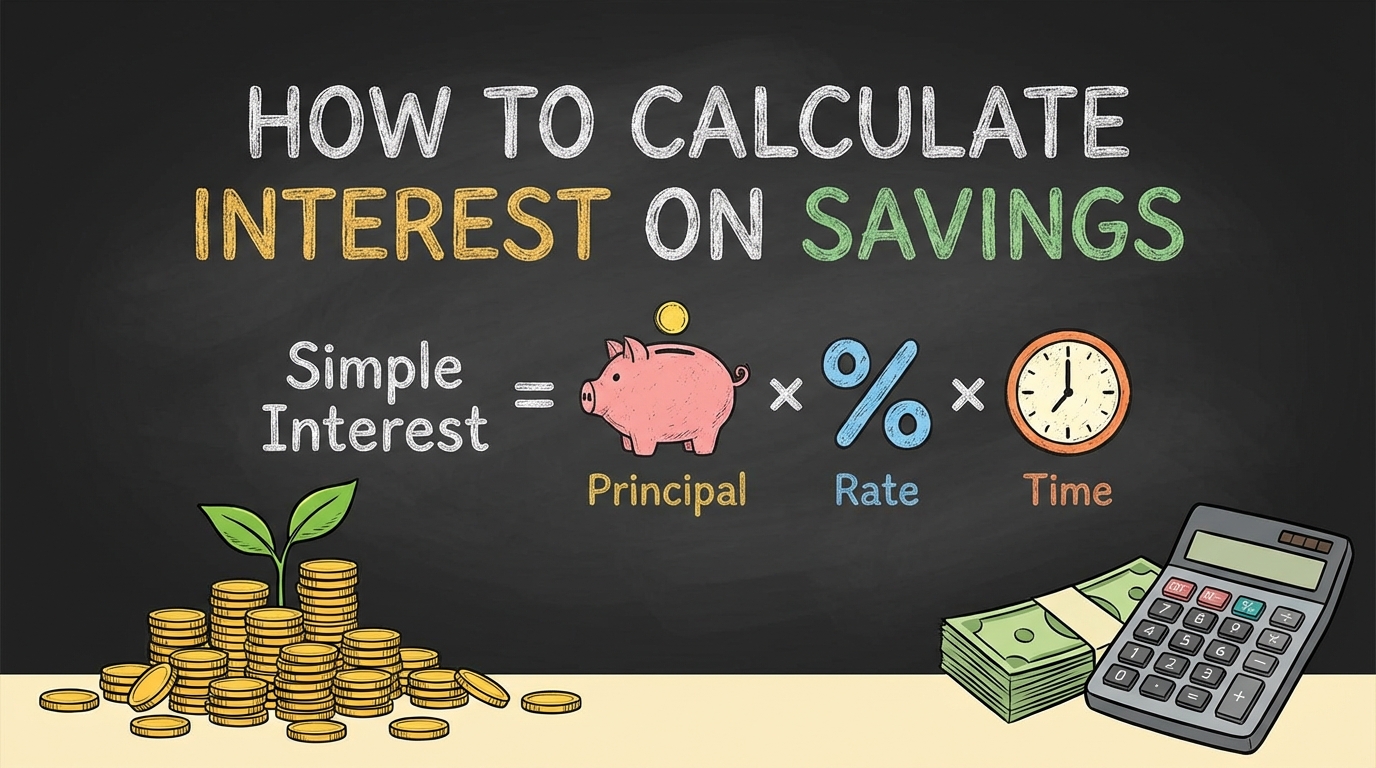
Saving money is an essential part of financial planning. Whether you’re putting money aside for an emergency fund, a new car, or future investments, understanding how interest works is crucial. Many people wonder “how do I calculate interest on savings?” or “what will my savings grow to over time?”
In this guide, we will cover:
- The basics of interest
- How to calculate simple and compound interest
- Real-life examples for savings accounts
- Tips to maximize your savings growth
- Using our free online interest calculator
By the end of this post, you’ll know exactly how to calculate interest on your savings and make your money work for you.
What Is Interest on Savings?
Interest on savings is the amount of money a bank or financial institution pays you for keeping your money in an account. It’s usually expressed as an annual percentage rate (APR).
For example, if you deposit $1,000 into a savings account with a 5% interest rate, you earn $50 in one year (simple interest).
There are two main types of interest:
- Simple Interest – Calculated only on the principal amount.
- Compound Interest – Calculated on the principal plus accumulated interest.
Simple Interest Formula
Simple interest is easy to calculate. The formula is:
Simple Interest = Principal × Rate × Time / 100
Example:
- Principal: $1,000
- Annual Interest Rate: 5%
- Time: 3 years
Calculation:
Simple Interest = 1000 × 5 × 3 / 100 = 150
Your savings will earn $150 over three years. Total balance = $1,150.
Use our free to use Simple Interest Calculator for quick interest calculations.
Compound Interest Formula
Compound interest is more powerful because interest is calculated on both the principal and the accumulated interest.
Formula:
A = P (1 + r/n)^(n×t)
Where:
A= Total amountP= Principalr= Annual interest rate (decimal)n= Number of compounding periods per yeart= Number of years
Example:
- Principal: $1,000
- Annual Interest Rate: 5%
- Compounded monthly (n=12)
- Time: 3 years
Calculation:
A = 1000 × (1 + 0.05/12)^(12×3) ≈ 1000 × 1.1616 ≈ $1,161.60
Your savings grow slightly faster than simple interest.
Try our Compound Interest Calculator for free to see your exact earnings.
Why Compound Interest Matters
Compound interest is often called the “eighth wonder of the world” because small deposits can grow significantly over time.
Example:
- $500 monthly savings
- 5% annual interest
- Compounded monthly for 10 years
Result: Over $78,000 in total, including interest.
Using a calculator helps visualize this growth.
Tip: Start saving early and make regular contributions to maximize compounding.
Step-by-Step Guide: Calculating Interest on Your Savings
Here’s a practical approach for any savings calculation:
Step 1: Identify Your Principal
This is the amount you deposit initially.
Example: $2,000
Step 2: Determine the Interest Rate
Check your bank or account details.
Example: 4% per year
Step 3: Choose the Type of Interest
- Simple: Only on principal
- Compound: On principal + interest
Step 4: Decide the Time Period
- In years or months
- Example: 5 years
Step 5: Use the Formula or Calculator
Simple: Multiply as shown earlier.
Compound: Use formula or online tool for accurate calculation.
Use our Free Interest Calculator to get instant results without manual math.
Real-Life Examples of Interest Calculations
Savings Account Example
- Deposit: $1,500
- Rate: 3% per year
- Time: 2 years
- Interest type: Simple
Interest = 1500 × 3 × 2 / 100 = $90
Total Balance: $1,590
Investment Example with Compound Interest
- Deposit: $5,000
- Rate: 6%
- Compounded quarterly (n=4)
- Time: 5 years
A = 5000 × (1 + 0.06/4)^(4×5) ≈ $6,744.59
Interest earned: $1,744.59
Tips to Maximize Savings Interest
- Compare Accounts – Look for higher interest rates and low fees.
- Consider Compounding Frequency – Monthly or daily compounding grows your money faster.
- Avoid Early Withdrawals – Some accounts reduce interest if you withdraw early.
- Automate Deposits – Regular contributions help compounding.
- Use Online Calculators – Helps forecast growth and plan better.
Use our free online Savings Calculator to plan your future savings.
Understanding Interest Rates and Inflation
When calculating interest on savings, it’s essential to consider inflation. Even if your savings earn 5% interest annually, an inflation rate of 3% means your real growth is only 2%. Accounting for inflation helps you understand the true value of your savings over time. Using an online savings calculator can help you adjust for inflation and plan more effectively.
The Impact of Compounding Frequency on Your Savings
The frequency of compounding—daily, monthly, quarterly, or yearly—significantly affects how much your savings grow. More frequent compounding results in faster growth because interest is calculated and added to the principal more often. Understanding this can help you choose the best savings account and maximize your earnings.
Use our online Compound Interest Calculator to experiment with different compounding frequencies and see the effect on your savings.
Planning for Long-Term Financial Goals
Calculating interest on savings is not just about knowing what you earn today—it’s about planning for the future. Whether you’re saving for a home, education, or retirement, understanding how interest works helps you estimate how much you need to save each month to reach your goals. Using an online interest calculator provides instant projections and can guide you in making smart financial decisions.
Why You Should Use an Online Interest Calculator
Manual interest calculations can be error-prone. Online interest calculators offer:
- Instant results
- Accurate calculations
- Options for simple and compound interest
- Easy comparisons for multiple scenarios
- Mobile-friendly access
Example Tools:
These tools save time and provide clarity for your financial decisions.
How to Calculate Interest on Savings?
Calculating interest on savings is essential for effective financial planning. Understanding simple and compound interest helps you:
- Plan for future goals
- Compare savings accounts
- Forecast investment growth
- Make smarter financial decisions
While formulas are helpful, using online calculators saves time and reduces errors.
Start calculating your interest now with our Free Interest Calculator and make your savings work harder for you.
Frequently Asked Questions (FAQ)
Q1: How often is interest calculated on savings?
Interest can be calculated daily, monthly, quarterly, or annually depending on your account.
Q2: What is the difference between simple and compound interest?
Simple interest is calculated only on the principal. Compound interest is calculated on both principal and accumulated interest.
Q3: Can I calculate interest for multiple deposits?
Yes, use a savings calculator that allows recurring deposits.
Q4: Is interest taxable?
In most countries, interest earned on savings is considered taxable income. Check local laws.