
Understanding how to calculate percentage decrease is an important skill used in many real-life situations. From price discounts and investment losses to sales declines and budget reductions, percentage decreases help you understand how much something has reduced relative to its original value.
Many people search for answers to questions like:
- How do you calculate percentage decrease?
- What is the percentage decrease formula?
- How do you calculate percentage decrease in Excel or manually?
- How do you find the percentage decrease between two numbers?
Fortunately, calculating percentage decrease is much easier than it may seem. Once you understand the simple formula and a few practical examples, you can quickly calculate percentage decreases in everyday scenarios.
In this guide you will learn:
- What percentage decrease means
- The simple percentage decrease formula
- Step-by-step calculation examples
- Real-life applications of percentage decrease
- How to calculate it instantly using an online tool
If you want to skip the manual calculations, you can also use our free percentage decrease calculator.
What Is Percentage Decrease?
A percentage decrease represents how much a value has dropped compared to its original amount, expressed as a percentage.
In simple terms, it tells you how much something has reduced relative to where it started.
For example:
- A product price drops from $100 to $75
- Website traffic decreases from 10,000 visitors to 8,000
- Company revenue falls from $1,000,000 to $850,000
In each case, the value becomes smaller, and the percentage decrease helps measure the scale of that reduction.
Percentages make it easier to compare decreases across different numbers.
For example:
- A $50 drop from $100 = 50% decrease
- A $50 drop from $1000 = 5% decrease
Even though the numeric drop is the same, the relative decrease is very different.
Percentage Decrease Formula
The percentage decrease formula is simple.
Percentage Decrease Formula
Percentage Decrease =
((Original Value − New Value) ÷ Original Value) × 100
This percentage calculation formula calculates the difference between the old value and the new value, then converts that difference into a percentage.
Step-by-Step Example of Percentage Decrease
Let’s look at a simple example of percentage decrease.
Example: Price Reduction
A laptop originally costs $800 but is now sold for $600.
Step 1: Subtract the new value from the original value
800 − 600 = 200
The price decreased by $200.
Step 2: Divide the difference by the original value
200 ÷ 800 = 0.25
Step 3: Convert to percentage
0.25 × 100 = 25%
Final Answer
The laptop price decreased by 25%.
If you want to avoid doing these steps manually, you can calculate it instantly using our free percentage change calculator online.
Another Example: Sales Decrease
Imagine a store had 1,500 sales last month, but this month they only had 1,200 sales.
Step 1
1500 − 1200 = 300
Sales dropped by 300.
Step 2
300 ÷ 1500 = 0.20
Step 3
0.20 × 100 = 20%
Final Result
Sales decreased by 20%.
Real-Life Uses of Percentage Decrease
Percentage decrease is used in many fields including finance, economics, education, and business analytics.
Here are some common scenarios of percentage decrease in practice.
Retail Discounts
Retail stores often advertise percentage reductions such as:
- 20% off
- 30% off
- 50% clearance sales
For example:
Original price = $120
Discounted price = $90
120 − 90 = 30
30 ÷ 120 = 0.25
0.25 × 100 = 25% decrease
Understanding this helps shoppers know whether a deal is actually worth it.
Investment Losses
Investors track the percentage decrease of assets to measure losses.
Example:
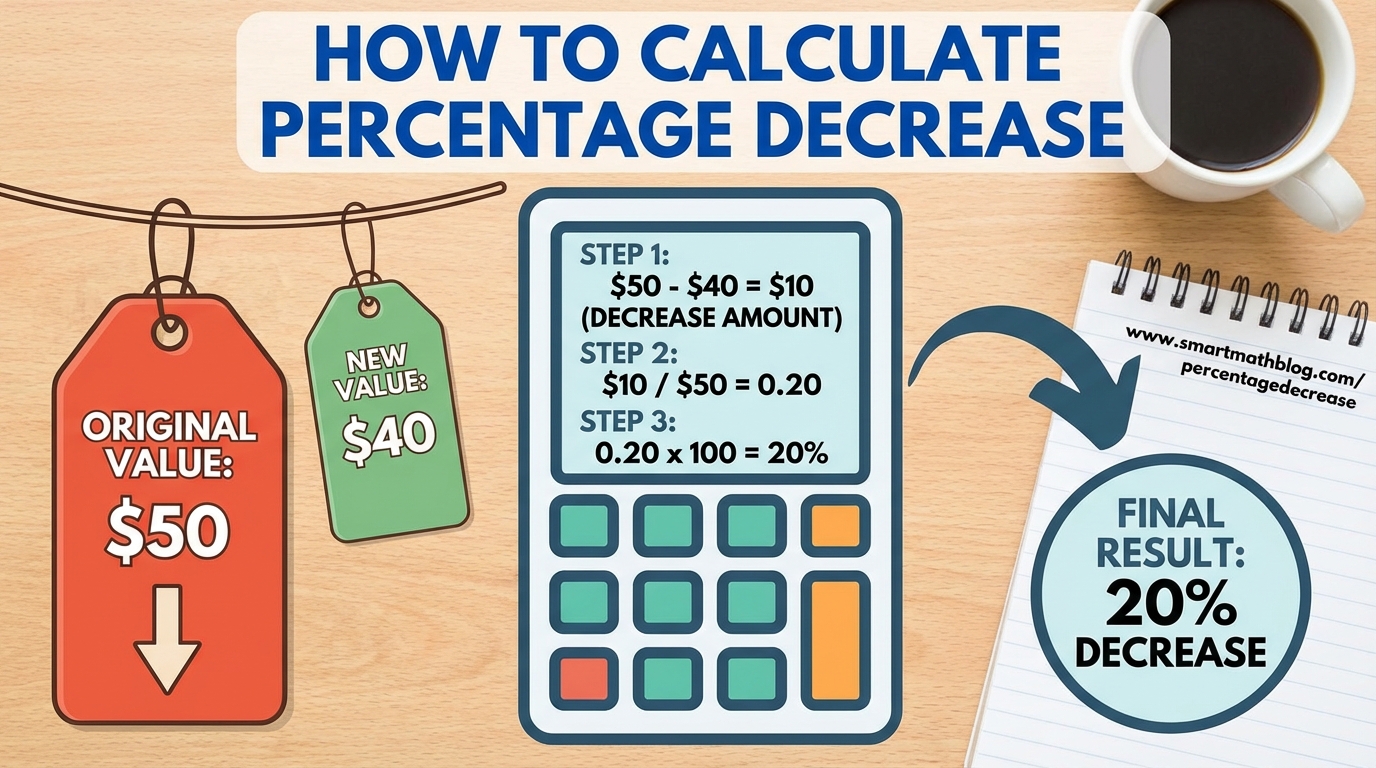
Stock price falls from $50 to $40
50 − 40 = 10
10 ÷ 50 = 0.20
0.20 × 100 = 20% decrease
This allows investors to compare losses across different assets.
Website Traffic Drops
Website owners frequently monitor traffic changes.
Example:
Traffic falls from 10,000 visitors to 7,500
10,000 − 7,500 = 2,500
2,500 ÷ 10,000 = 0.25
0.25 × 100 = 25% decrease
This helps businesses analyze marketing performance.
Common Mistakes When Calculating Percentage Decrease
Although the formula is simple, people often make mistakes.
Using the wrong base value
Always divide by the original value, not the new value.
Incorrect:
Difference ÷ New Value
Correct:
Difference ÷ Original Value
Forgetting to multiply by 100
After dividing the difference, remember to multiply by 100 to convert the decimal into a percentage.
Confusing percentage change with difference
Example:
$100 → $80
Difference = $20
Percentage decrease = 20%
The difference and the percentage are not the same.
Fastest Way to Calculate Percentage Decrease
While manual calculations work, the fastest method is using an online percentage calculator.
An online calculator:
- Eliminates calculation errors
- Provides instant results
- Works on any device
- Saves time for repeated calculations
You can quickly calculate percentage decreases with our free percentage decrease calculation tool.
Just enter the original value and the new value, and the percentage calculator instantly calculates the percentage change.
Percentage Decrease vs Percentage Increase
It’s important to distinguish between percentage decrease and percentage increase.
Percentage Increase
Measures how much something has grown.
Example:
$100 → $120
Increase = 20%
Percentage Decrease
Measures how much something has reduced.
Example:
$100 → $80
Decrease = 20%
Both calculations use similar formulas but interpret the change differently.
Why Understanding Percentage Decrease Is Important
Learning how to calculate percentage decrease helps with:
Better financial decisions
Understanding price drops and investment losses.
Shopping smarter
Knowing the real value of discounts.
Business analysis
Tracking revenue, expenses, and performance changes.
Data interpretation
Comparing trends across different datasets.
Percentage calculations make complex data easier to understand.
Use Our Free Percentage Change Calculator
If you regularly work with percentages, using a calculator saves time and prevents mistakes.
Our free tool helps you instantly calculate:
- Percentage increase
- Percentage decrease
- Percentage change between two numbers
Try our free percentage change calculator today!
The calculator works on desktop, tablet, and mobile devices and is completely free to use.
How to Calculate Percentage Decrease Easily
Calculating percentage decrease is a simple but powerful way to measure how much a value has dropped relative to its original amount.
The percentage decrease formula is straightforward:
((Original Value − New Value) ÷ Original Value) × 100
By following this method, you can easily determine percentage reductions in prices, sales, investments, or any other measurable value.
However, if you want faster and more accurate results, using an online percentage decrease calculator is often the best option.
You can calculate percentage decreases instantly using our free tool.
FAQ – Percentage Decrease
What is percentage decrease?
Percentage decrease measures how much a value has reduced compared to its original value. It is expressed as a percentage of the original amount and helps compare reductions across different numbers.
For example, if a product price drops from $100 to $80, the decrease is $20. When converted to a percentage, the price decreased by 20%.
What is the formula for percentage decrease?
The percentage decrease formula is:
Percentage Decrease = ((Original Value − New Value) ÷ Original Value) × 100
This formula calculates the difference between the two values and then converts that difference into a percentage relative to the original value.
How do you calculate percentage decrease between two numbers?
To calculate percentage decrease between two numbers:
- Subtract the new value from the original value
- Divide the difference by the original value
- Multiply the result by 100
Example:
Original value = 200
New value = 150
Step 1:
200 − 150 = 50
Step 2:
50 ÷ 200 = 0.25
Step 3:
0.25 × 100 = 25% decrease
How do you calculate percentage decrease quickly?
The fastest way to calculate percentage decrease is by using an online calculator.
Instead of performing the formula manually, you can simply enter the original value and the new value to get the result instantly.
You can try our free percentage change calculator to calculate percentage decrease online.
What is the difference between percentage decrease and percentage change?
Percentage decrease only measures reductions in value, while percentage change measures both increases and decreases.
For example:
100 → 80 = 20% decrease
100 → 120 = 20% increase
A percentage change calculator can determine both types of changes automatically.